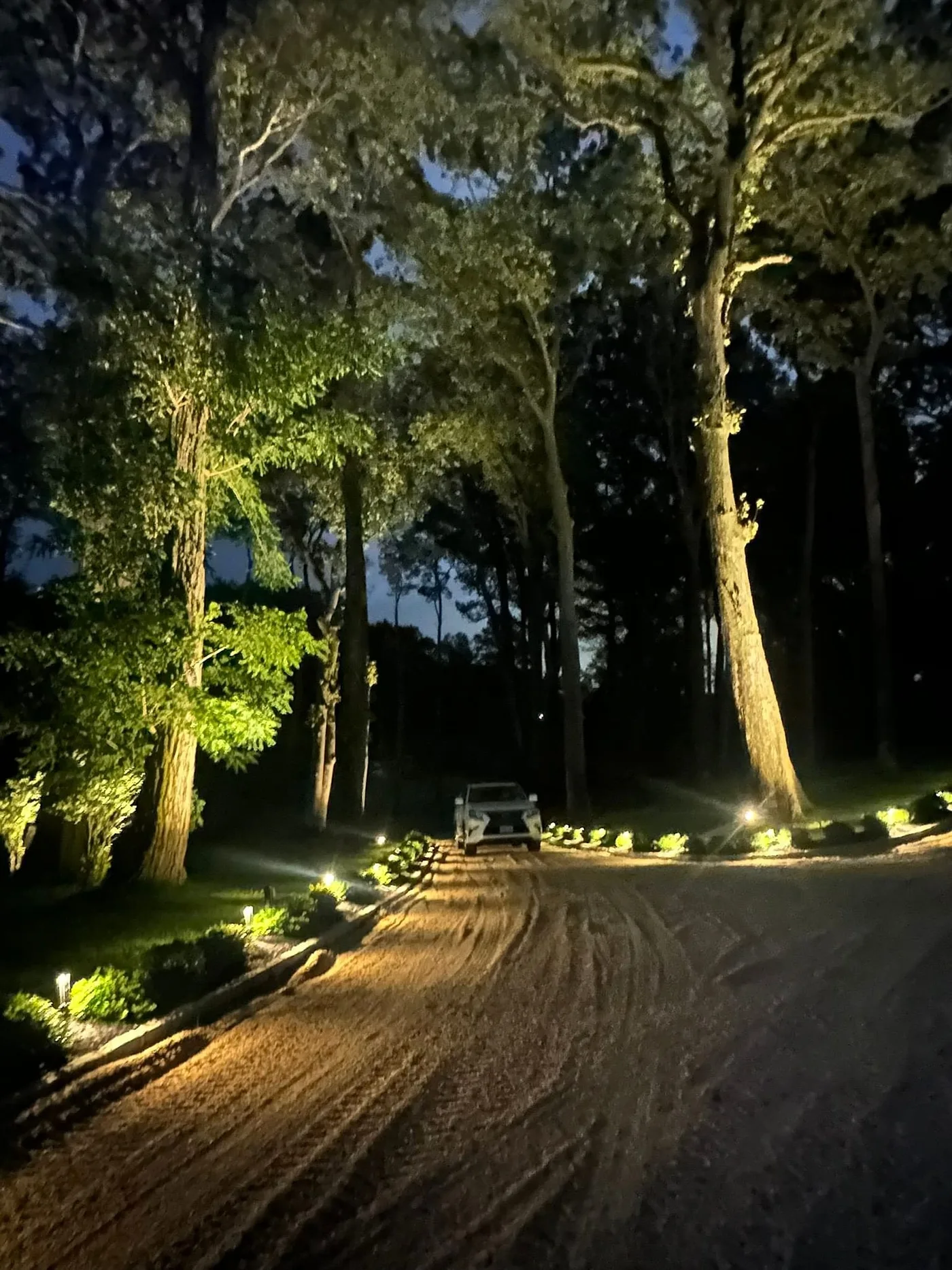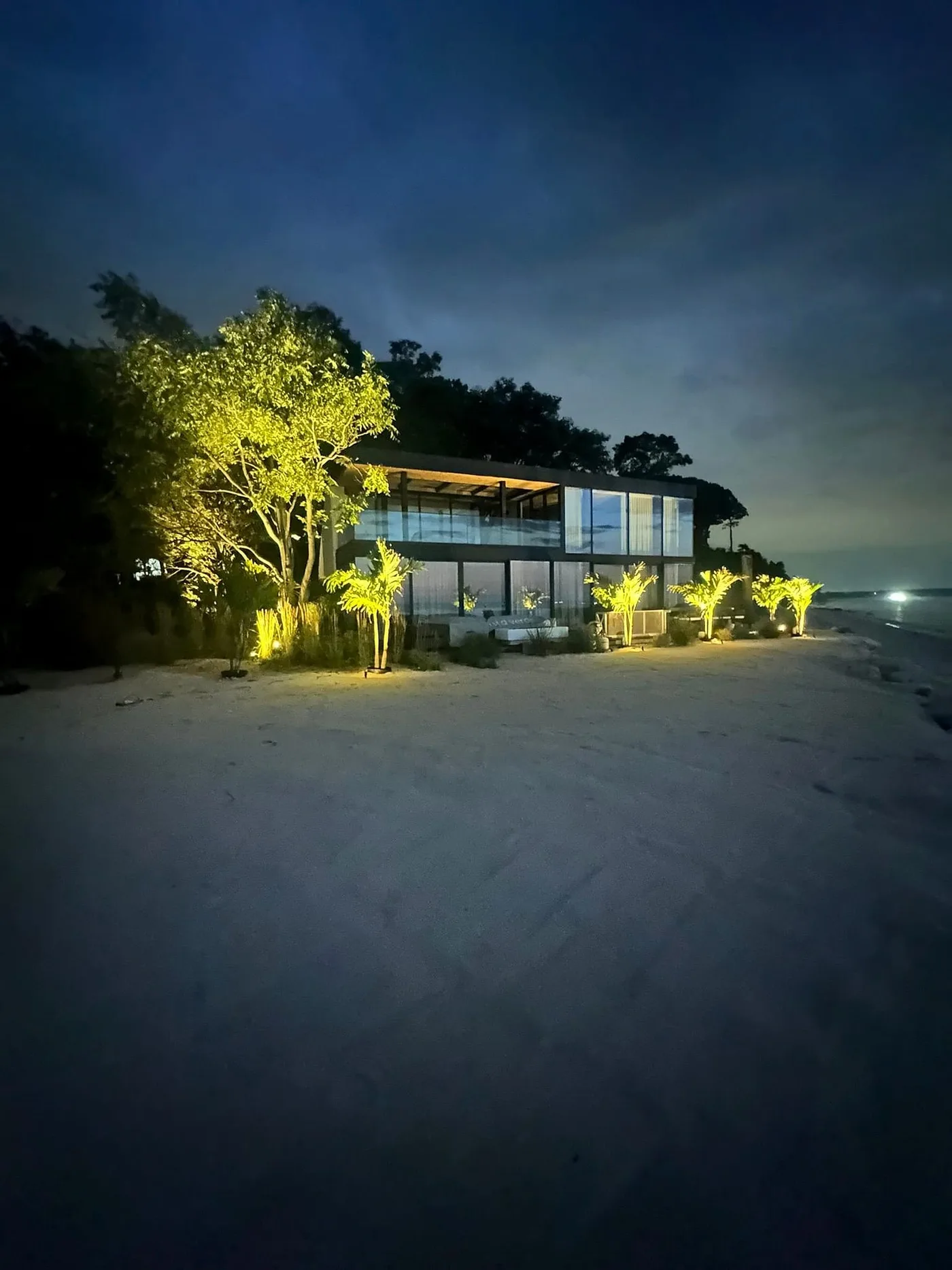
Lighting the property, not just the path
Outdoor lighting has three jobs, and most installations only do one of them. Safety lighting gets people from the car to the door and down the steps to the pool. Architectural lighting gives the facade shape at night by grazing stone, washing columns and marking the entry. Landscape lighting picks out specimen trees, hedges, gardens and water features so the view from inside the house does not end at black glass. A considered design balances all three and leaves deliberate darkness in between, which is what makes a lit property look composed rather than bright.
We start with how the property is actually used after dark. Do guests arrive by the front motor court or a side drive? Is the pool used at night in summer? Which rooms look out over the lawn? Where are the neighbors, and which windows face them? Those answers decide where light is needed, where it would be wasted, and which views deserve attention.
Fixture techniques and placement
Different surfaces call for different techniques. Uplighting reveals trunk and canopy structure on mature trees. Grazing places fixtures close to textured stone or shingle so the surface casts its own shadows. Downlighting from trees or eaves imitates moonlight and creates soft patterns on lawns and terraces. Path lights and step lights are spaced to show edges and changes in level rather than lining a walk like a runway.
Glare control is the difference between refined and harsh. Fixtures are aimed and shielded so the lamp itself is not visible from seating areas, windows or the street, and beam spreads are chosen to suit each target. We pay particular attention to light spilling onto neighboring properties and into the night sky, both because it is courteous and because local codes in many Long Island and East End villages address exterior lighting.
- Facade and entry: grazing, wall washing and soft accent on columns and doors
- Trees and planting: uplighting, moonlighting and silhouette effects
- Circulation: path, step and driveway marker lighting
- Outdoor living: pool, terrace, pergola and outdoor kitchen lighting
Lutron control for exterior scenes
Outdoor lighting is far more useful when it is part of a control system instead of a set of mechanical timers. Connected to Lutron HomeWorks or another suitable Lutron platform, exterior zones can follow astronomic timing so they come on relative to sunset and dim to a lower level late at night. An Arrival scene can raise driveway and entry lighting when the gate opens; an Entertain scene can bring the pool, terrace and trees up together; and a Goodnight button can drop everything to a quiet security level.
Dimming matters outside as much as inside. Many exterior zones look best well below full output, and the right levels are set at night during commissioning rather than guessed during the day. With Crestron automation, outdoor scenes can also coordinate with outdoor audio, security cameras and vacation modes that simulate occupancy.
Low voltage, line voltage and equipment
Most landscape lighting runs on low-voltage fixtures fed from transformers, while some architectural fixtures and pole lights are line voltage and are installed by a licensed electrician. Part of our design work is deciding which approach suits each zone, how fixtures are grouped onto circuits for meaningful scenes, and where transformers and control equipment can live without being an eyesore. Fixture housings, finishes and lamp color temperature are chosen to suit coastal exposure and the architecture.
Manufacturers such as Coastal Source build outdoor lighting and audio for harsh environments, and we specify fixtures from several manufacturers depending on the effect, finish and control compatibility a project needs.
Running wire through an established landscape
On new construction, conduit and wire can be placed while the grounds are open. On mature properties the challenge is reaching trees, beds and walls without tearing up lawns. Where conditions allow, we use trenchless line-laying to place cable beneath turf with far less disturbance than an open trench. Crossings under driveways, walks and patios are planned separately with appropriate equipment and depend on site conditions. Utility locates are always requested before any digging.
Designing with landscape architects and builders
Exterior lighting works best when it is planned with the landscape design rather than added after the plants go in. We review landscape plans, mark fixture locations, and coordinate sleeves under hardscape before paving is installed. Our design and engineering team prepares lighting layouts and zone schedules so the landscape architect, electrician and builder are all working from the same drawings.
Plantings grow, so designs allow for adjustment. A young tree may need one fixture now and a second in a few years; hedges may need fixtures moved as they fill in. We plan spare capacity on transformers and control circuits to keep those changes simple.
Night commissioning and seasonal care
Aiming is done after dark. We return at night to adjust each fixture, set levels and build scenes while viewing the property from the drive, the terrace and inside the main rooms. That walk-through is where good design becomes good lighting.
Exterior systems need occasional attention: fixtures are knocked by mowers, plants overgrow beams and timers drift on systems without astronomic control. Ongoing support includes seasonal adjustments and scene changes as the way you use the garden evolves. The same approach applies to clients with waterfront homes in Florida, where salt exposure and year-round outdoor living make fixture selection especially important.
Color, mood and how much light is enough
Outdoor lighting rarely needs to be bright. The eye adapts quickly at night, and a few well-placed, low-level sources usually look better than a few powerful ones. We generally favor warm color temperatures that flatter stone, wood and foliage, and we keep the color consistent across fixtures so the property reads as one composition. Where a client wants cooler moonlight on certain trees or color for a party, those effects are kept to specific zones and scenes rather than applied everywhere.
Balance between inside and outside matters too. When interior rooms are lit at evening levels, a dark garden turns windows into mirrors. Gentle exterior light on trees and terraces lets the view continue past the glass. We set exterior scene levels while standing inside the main rooms so the relationship between the two feels natural.
Finally, we think about late night. After guests leave, most of the property can drop to a quiet level with only paths, steps and entry lighting remaining. That saves energy, reduces light pollution and still leaves the house welcoming when someone arrives home late.