Why the underground pathway decides an outdoor project
Speakers around a pool, a camera at the end of the driveway, an intercom at the gate, network service to a pool house or a detached garage: each one needs a protected route back to the equipment rack. On new construction that route is easy to place while the site is open. On a finished property with mature lawns, planting and stone, the question becomes how to get cable where it needs to go without leaving a scar across the yard or a run that cannot be replaced later.
That is why we treat the underground work as part of the system design rather than an afterthought. A speaker run buried without conduit works on day one. Ten years later, when a landscaper's spade nicks it or the owner wants to add a subwoofer, the difference between a conduit with a pull string and a direct-buried cable is the difference between an afternoon and a torn-up lawn. Our outdoor audio and network projects are planned with this in mind from the first site walk.
Conduit and underground piping
On most runs that matter, we place conduit. It protects the cable from shovels, roots and rodents, and it means the cable can be pulled out and replaced, or a second cable added, without digging again. Conduit size is chosen for what the run carries today plus reasonable room for what it may carry later, and every run is left with a pull string.
We keep low-voltage pathways separate from electrical and irrigation, and we note depth and route as the work is done. Where a run crosses under a future patio or planting bed, we place a spare conduit while the ground is open, because an empty sleeve costs very little compared with cutting through finished stone later.
- Conduit to speakers and subwoofers around pools, terraces and lawns
- Feeds to gate stations, intercoms, driveway cameras and sensors
- Network and low-voltage service to pool houses, cottages and garages
- Spare sleeves under future hardscape while the site is open
Hand-bent pipe instead of tight fittings
Where a run changes direction, especially where it rises out of the ground at a building wall, a speaker location or a gate post, we often hand-bend the pipe rather than relying on tight factory elbows. A gradual sweep makes the next cable pull far easier and reduces the chance of damaging a jacket on a sharp corner. It takes longer to do by hand, and it is one of those details that nobody sees once the work is backfilled.
Where pipe comes up beside the house or into a planting bed, we plan the riser so it is protected and as unobtrusive as possible, and we coordinate its position with the landscape and masonry trades so it does not end up in the middle of a walkway.
Hot boxes and accessible junctions
Long runs and branch points get an in-ground box, sometimes called a hot box or pull box, so the cable can be accessed without digging. Boxes are placed where they can be found and opened, kept out of mowing lines where possible, and recorded on the drawings so a future technician knows where to look.
A box at the right place is what makes a system serviceable. It is where a speaker branch splits, where a long gate run can be pulled in two shorter sections, and where a fault can be isolated without guessing. We would rather set one more box than leave a run that can only be repaired by excavation.
Line Ward line-laying under established lawns
On finished properties with mature turf, we use a Line Ward line-laying machine for suitable lawn runs. The machine cuts a narrow slot and feeds cable or small pipe in behind the blade at depth, and the turf closes back over it. On the right soil, the line is hard to find within a short time, with far less disruption than an open trench.
It is a tool, not a promise. Results depend on soil, roots, rocks, moisture, slope and what is already buried. Entry points, junctions and fixture locations still need some restoration. We explain where line-laying fits a run and where conventional trenching or hand digging is the better choice, and we choose the method that suits the ground rather than the other way around.
Driveways, walks and hardscape crossings
Line-laying places cable under turf and soil. Driveways, walks, patios, pool decks and stone walls are a separate problem. Depending on length, materials, soil and existing services, a crossing may use an existing sleeve, a route around the paving, a bore by an appropriate contractor, or a planned cut coordinated with the masonry trade. We identify every crossing during design so there are no surprises on installation day.
Locates, private lines and coordination
Before any ground disturbance, a public utility locate is requested. Private lines that utilities do not mark, such as irrigation, lighting, septic, propane, pool plumbing and pet fence, are identified with the owner and, where needed, a private locator. We work around what we find and record our own runs as we go.
Outdoor projects usually involve the landscape designer, the pool contractor and the mason. We share route drawings, schedule underground work before new sod or planting where possible, and keep boxes and risers where they will remain accessible once the landscape is finished.
About the photo on this page
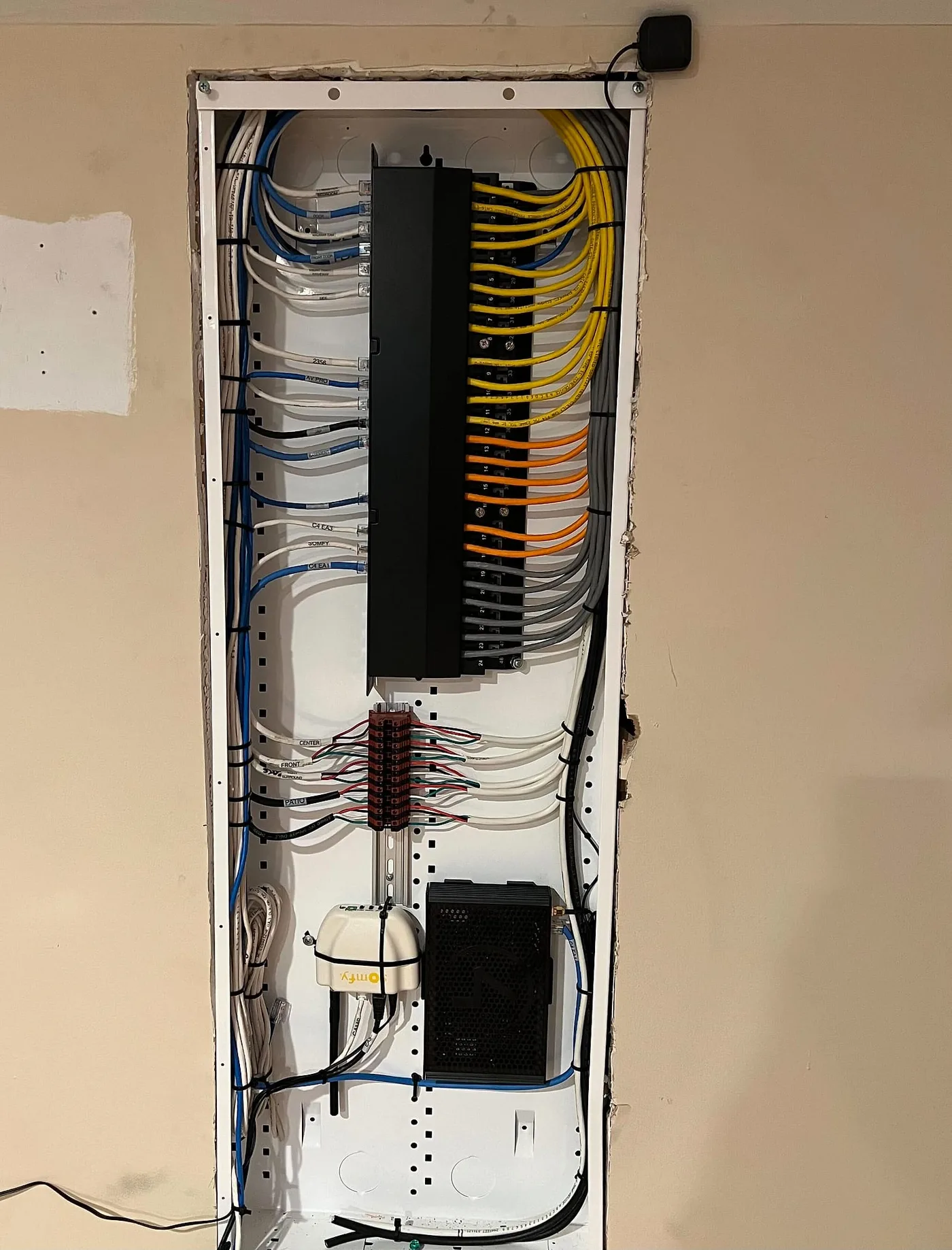
The photograph above shows indoor prewire: low-voltage cable home-run and labeled before walls close. It is shown as an example of how we run and label cable, not as an underground installation. We are preparing dedicated photography of our conduit, hand-bent pipe and line-laying work. In the meantime, schedule a consultation and we will walk your property and explain the route for each run.