What certification testing means here
The phrase "Fluke certified" gets used loosely, so we want to be precise. On our projects it refers to the cable, not the technician or a manufacturer program: every installed copper or fiber run we terminate is tested with Fluke Networks certification test equipment against a selected test standard, and the saved result is tied to that run's label. It is a statement about how installed cabling is verified and documented.
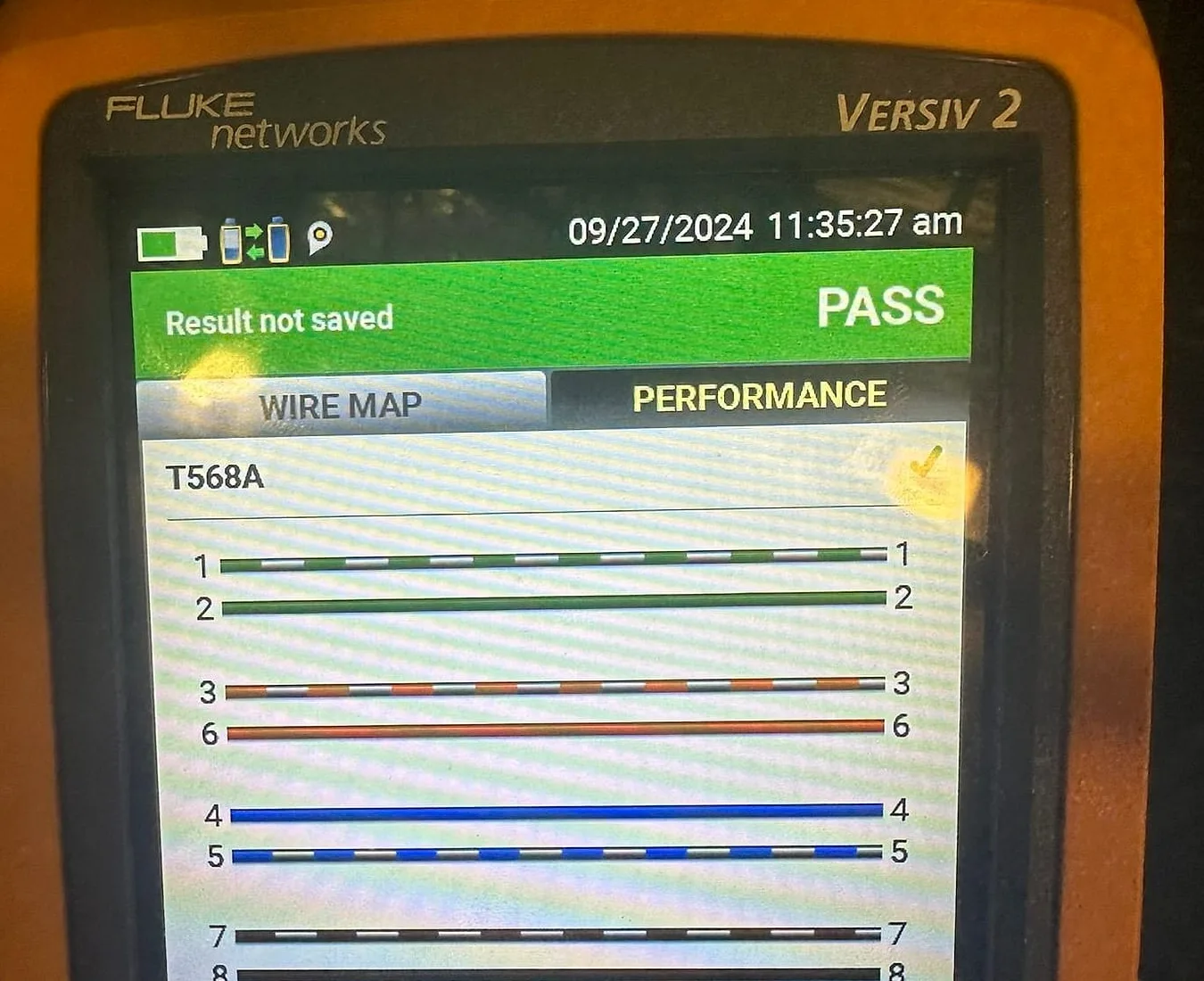
Fluke Networks' own documentation draws an important distinction. Not every Fluke device is a certification tester. Simple continuity testers and wiremap tools confirm that pins are connected correctly; qualification testers check whether a link can support a given network speed. Certification is a different level: the tester measures a run's performance parameters against the limits of a chosen standard, such as a TIA or ISO category or permanent-link specification, and records a pass or fail result that can be saved, reviewed and reported. Those saved, labeled results are what make certification meaningful.
Why test every run
A cable can carry a signal and still be a problem. A kinked run, an untwisted termination, a staple pulled too tight or a run that exceeds length limits may work at low speeds and fail under load, often intermittently. Those faults are hard to diagnose after drywall, millwork and finishes are in place, and they tend to show up as vague complaints: a WiFi access point that drops, a camera that freezes, a streaming device that buffers or a touch panel that loses connection.
Testing every run during installation catches problems while they are still easy to fix. It also creates a baseline. If a device misbehaves years later, the original result shows how the cable performed when installed, which helps separate a cabling fault from an equipment or configuration issue.
- Each run labeled at both ends with a consistent scheme
- Tested against a selected standard appropriate to the cable and application
- Results saved and tied to the cable label
- Failures corrected and retested before handoff
Designing the cabling plant
Testing proves the installation, but design decides whether the installation is right. We plan cable types, counts and routes as part of our design and engineering drawings: home runs from each touch panel, access point, camera, display and network jack back to a central equipment rack or distributed closets, with spare capacity in difficult locations. Category copper is used for most endpoints, while fiber connects buildings, distant closets and high-bandwidth backbones.
Pathways matter too. Where practical, we place conduit or open pathways to make future additions possible without opening finished walls. Cable is kept away from sources of interference, supported properly and separated from line-voltage wiring according to code. On estates, runs to pool houses and gates may cross lawns, where we evaluate trenchless line-laying.
Labeling, racks and terminations
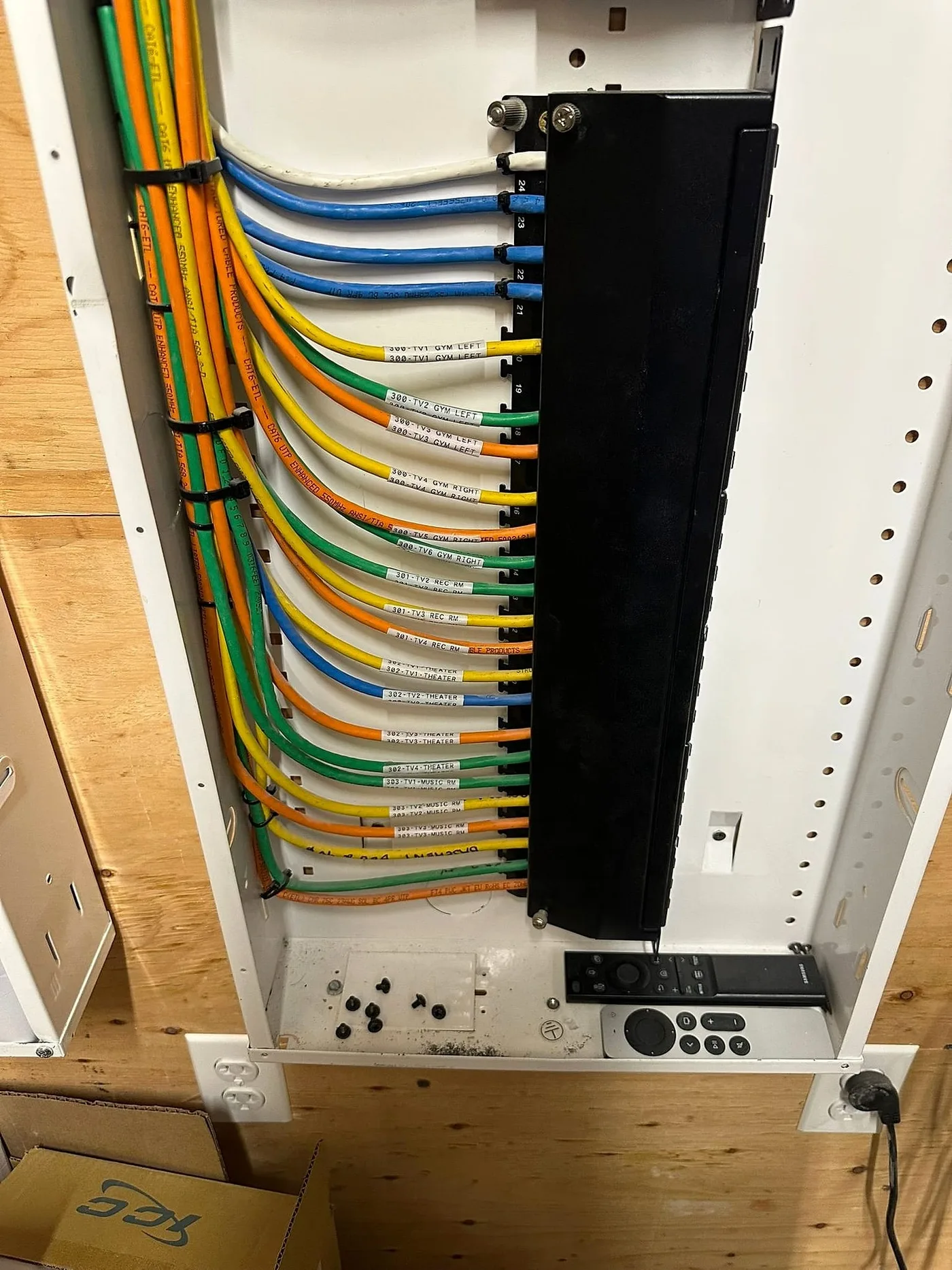
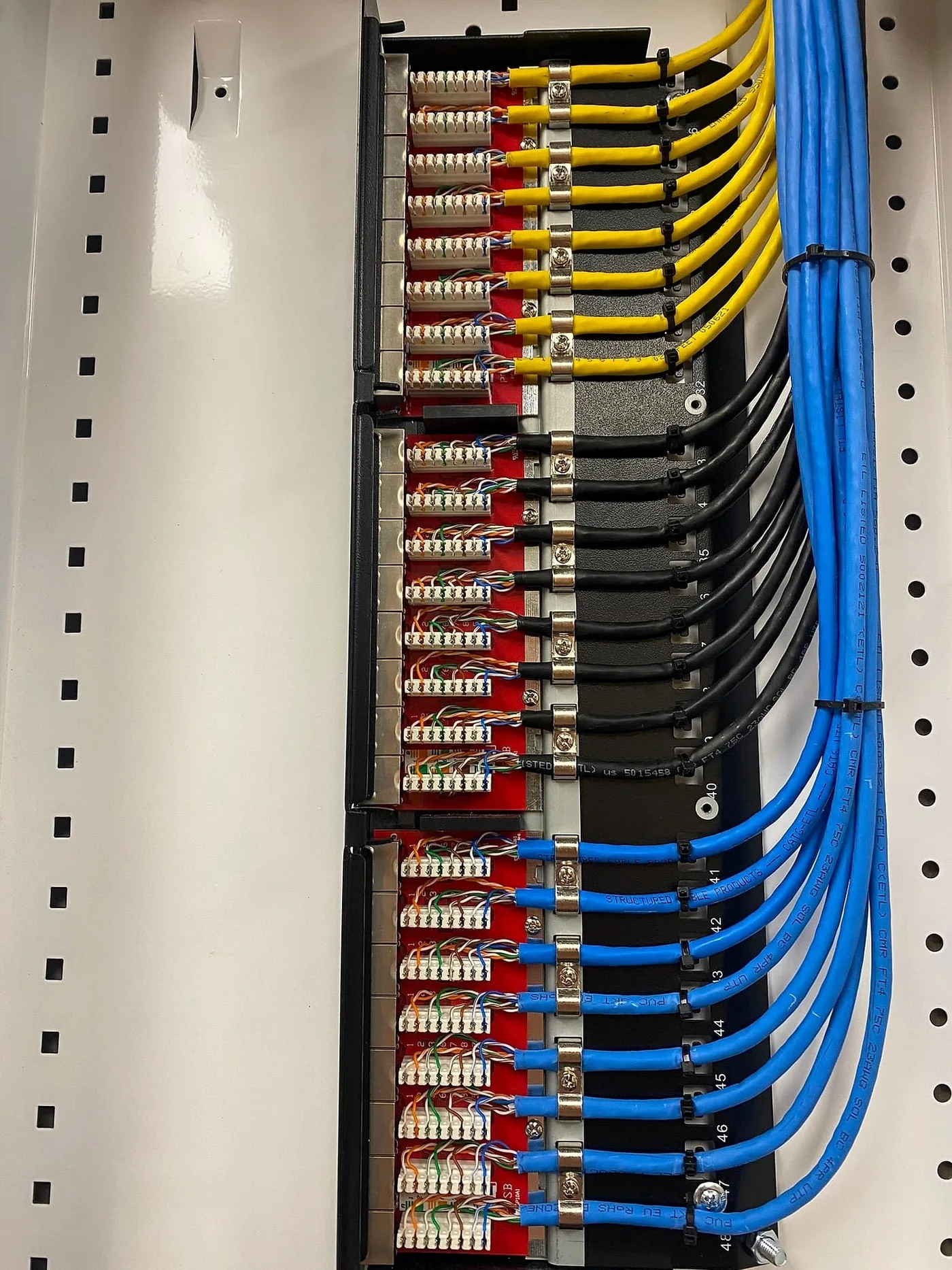
A clean rack is not just aesthetics. Patch panels, labeled ports and organized cable management make it possible for anyone on our team to trace a connection quickly. Labels match the drawings, the patch panel and the saved test result, so a cable identified at a wall plate can be found at the rack and in the documentation without guesswork.
Terminations are made to the manufacturer's specifications for the jack or connector used, and the installed link is what gets tested, including the jacks at each end. Rack layout is shown in our elevations, with power, ventilation and battery backup planned alongside the home network equipment.
Fiber, outbuildings and backbones
Fiber links are tested with methods appropriate to fiber, such as loss testing against the selected standard and limits, and those results are saved and labeled the same way as copper. Fiber is often the right choice between buildings on a property because it is unaffected by electrical differences between structures and supports high bandwidth over long distances. Connector cleanliness and inspection are part of the process because dirty connectors are a common cause of fiber faults.
Homes, hotels and commercial spaces
The same discipline applies whether the building is a residence or a commercial property. In homes, a tested cabling plant supports automation, security cameras, audio, video distribution and work-from-home networks. In hospitality and commercial settings, cabling may serve guest rooms, back-of-house operations, point-of-sale systems and meeting spaces, often with separate networks and strict documentation requirements from owners or IT departments.
We can also test existing cabling before reusing it in a renovation. Results show which runs can stay and which should be replaced, which is often more economical than replacing everything or trusting cable that has never been verified.
What you receive at handoff
At the end of installation you receive the cable schedule, labeled drawings and the saved test reports for the installed runs, organized by label so they can be matched to each location. These records belong to the owner and are useful to any future integrator, electrician or IT team working on the property. The same documentation approach is used for clients with properties in Florida, so records look consistent across homes.
Certification testing verifies that installed cabling met the selected standard when tested. It is not a warranty of connected equipment, and it is separate from any cable manufacturer's warranty program, which may have its own requirements.
Common faults testing catches
Certification testing tends to find a familiar set of problems. Wiremap errors such as split pairs or reversed conductors come from termination mistakes. Excessive length shows up on runs that wandered around obstacles. Near-end crosstalk failures often point to untwisting at the jack or a damaged section where cable was crushed or bent too tightly. Return loss problems can come from poor terminations or mismatched components. Each failure is investigated, corrected and retested, and only the passing result goes into the final report.
Finding these problems during installation is far cheaper than finding them after finishes are complete. A cable that fails behind open studs can be re-terminated or replaced in minutes. The same cable found months later behind plaster, stone or custom millwork can mean opening finished surfaces or running a new route.
Testing also protects the rest of the trades. When a network device fails to connect, a saved passing result for its cable lets the team look first at configuration or equipment, which shortens troubleshooting for everyone on the project.